TL;DR
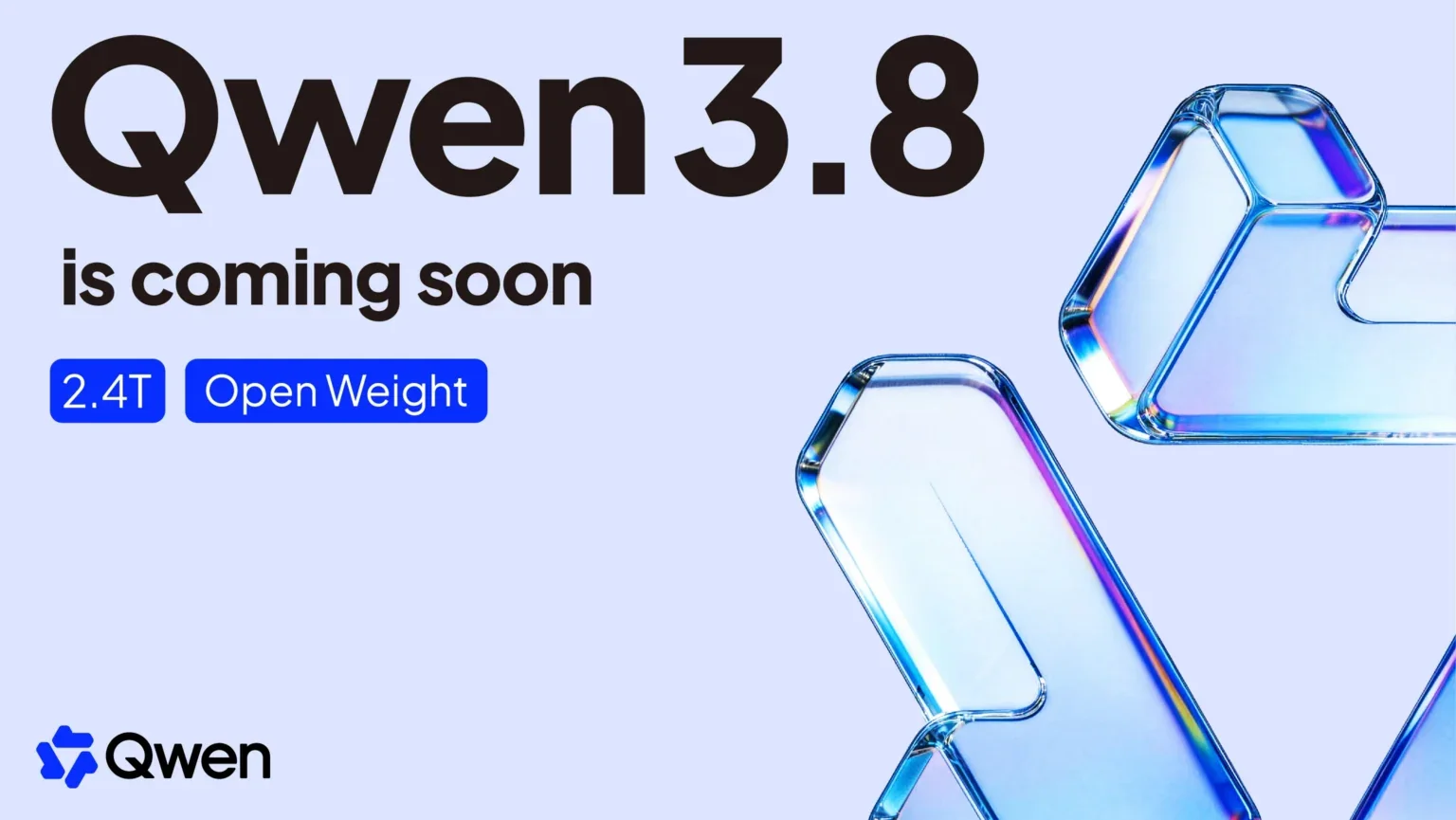
Qwen 3.8 Max Preview (Qwen3.8-Max-Preview) is Alibaba's most powerful open-source AI model, packing 2.4 trillion parameters and a 1M-token context window. Released in late July 2026, it is already turning heads in the developer community for one simple reason: it delivers near-Fable-5-level coding and agent performance at 5x to 10x lower cost. It integrates directly with Claude Code via a dashscope API endpoint, generates complete Three.js 3D applications from single prompts, and handles multimodal tasks like chopstick counting with high accuracy. The full version is slated for open-source release soon. This review covers real-world tests, benchmarks, pricing, and how Qwen 3.8 stacks up against Fable 5, Kimi K3, and Grok 4.5.
Quick Facts
| Metric | Data |
|---|---|
| Developer | Alibaba (Qwen Team) |
| Release Date | July 21, 2026 (Preview) |
| Total Parameters | ~2.4T (2.4 trillion) |
| Context Window | 1,000,000 tokens (1M) |
| Multimodal | Yes — text + image input supported |
| Open Source | Planned — official release coming soon |
| Key Integrations | Claude Code (via Anthropic-compatible API), dashscope |
| Cost per Complex Task | ~$0.06 (0.4 RMB) — ~10x cheaper than Fable 5 |
| VoxelArt Bench Rank | #3 — behind Fable 5 ≈ Kimi K3, ahead of GLM-5.2, Grok 4.5, GPT-5.6 Sol |
| Pricing | Free Preview / API pay-per-use (extremely low) |
Why Qwen 3.8 Matters
In the span of one week, the AI open-source community went from Kimi K3's release to Qwen 3.8 Max Preview — and the latter has arguably made the bigger splash. Three things make this release significant:
1. 2.4T Parameters, Open-Source, and 1M Context — All at Once
A 2.4-trillion-parameter model is enormous by any standard. But the real story is the combination: massive scale, a 1M-token context window (enough to ingest entire codebases or book series), multimodal input support, and a confirmed plan to open-source the weights. No other model in this class offers all four. If Alibaba delivers on the open-source promise, Qwen 3.8 could become the default foundation for fine-tuned coding models worldwide.
2. The Price Difference Is Not Incremental — It Is an Order of Magnitude
Across multiple independent tests, the same complex tasks cost roughly:
• Qwen 3.8: ~0.4 RMB (~$0.06)
• Kimi K3: ~3.4 RMB (~$0.47)
• Fable 5: ~5.4 RMB (~$0.75)
That is a 8.5–12.5x cost advantage over Fable 5, and a 7.8x advantage over Kimi K3. For developers running hundreds of agent tasks per day, this difference compounds into hundreds of dollars saved per month. At these prices, Qwen 3.8 makes it economically viable to run AI agents at scale — something that was previously reserved for well-funded teams.
3. Claude Code Compatibility — Drop-in Replacement
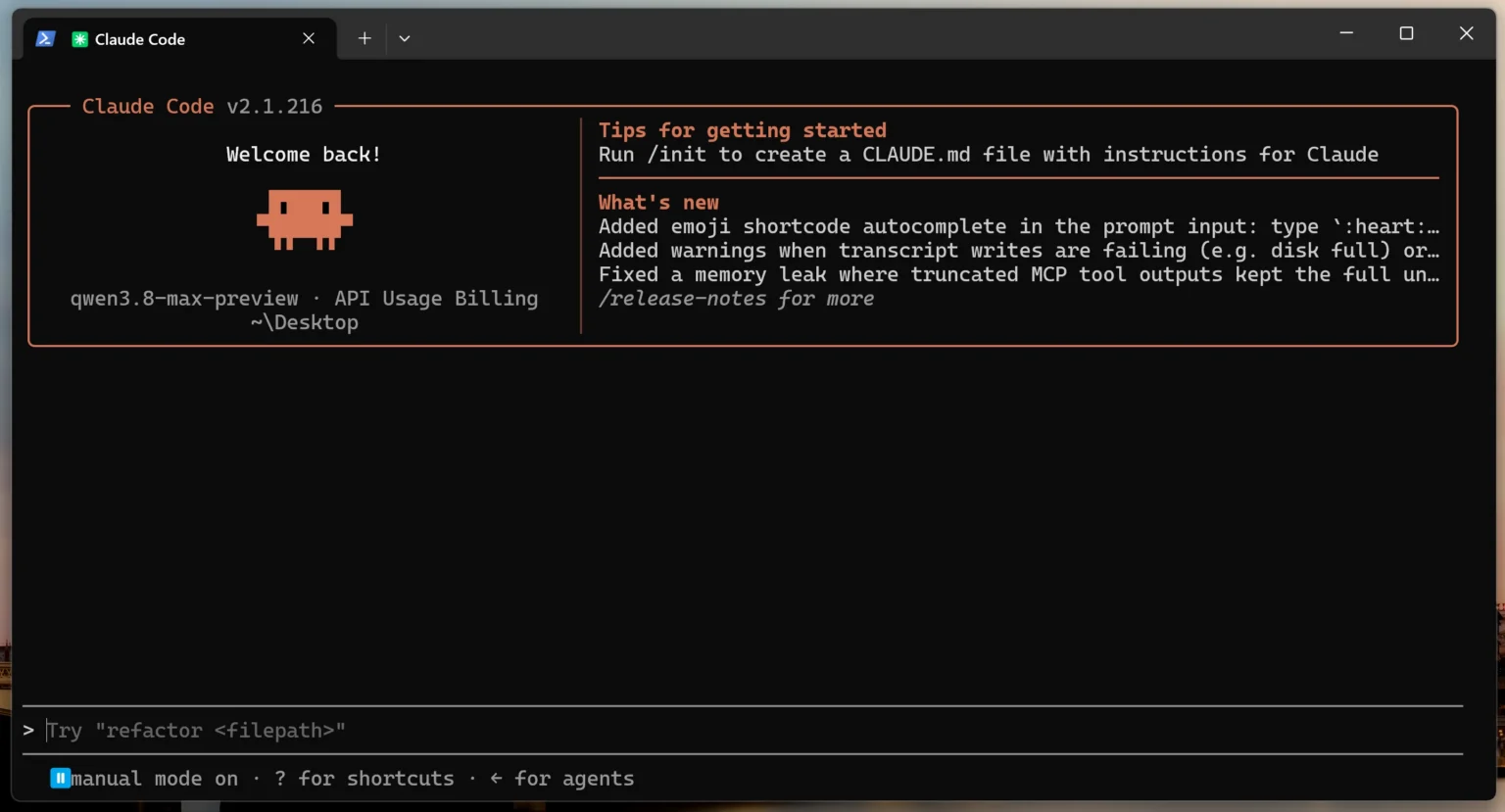
Qwen 3.8 exposes an Anthropic-compatible API endpoint through Alibaba's dashscope platform. This means you can literally point Claude Code at Qwen 3.8 by changing three environment variables: ANTHROPIC_BASE_URL, ANTHROPIC_MODEL, and your API key. No code changes, no SDK migration. For the growing ecosystem of tools built on the Anthropic API, Qwen 3.8 is a near-zero-friction alternative that costs a fraction of the price.
"Qwen 3.8 is not trying to beat Fable 5 at everything. It is trying to give you 90% of the performance for 10% of the cost — and for most real-world coding tasks, that trade-off makes overwhelming sense."
Real-World Tests: What Qwen 3.8 Can Actually Do
Test 1: 3D AI Chip — A Fully Programmatic Masterpiece
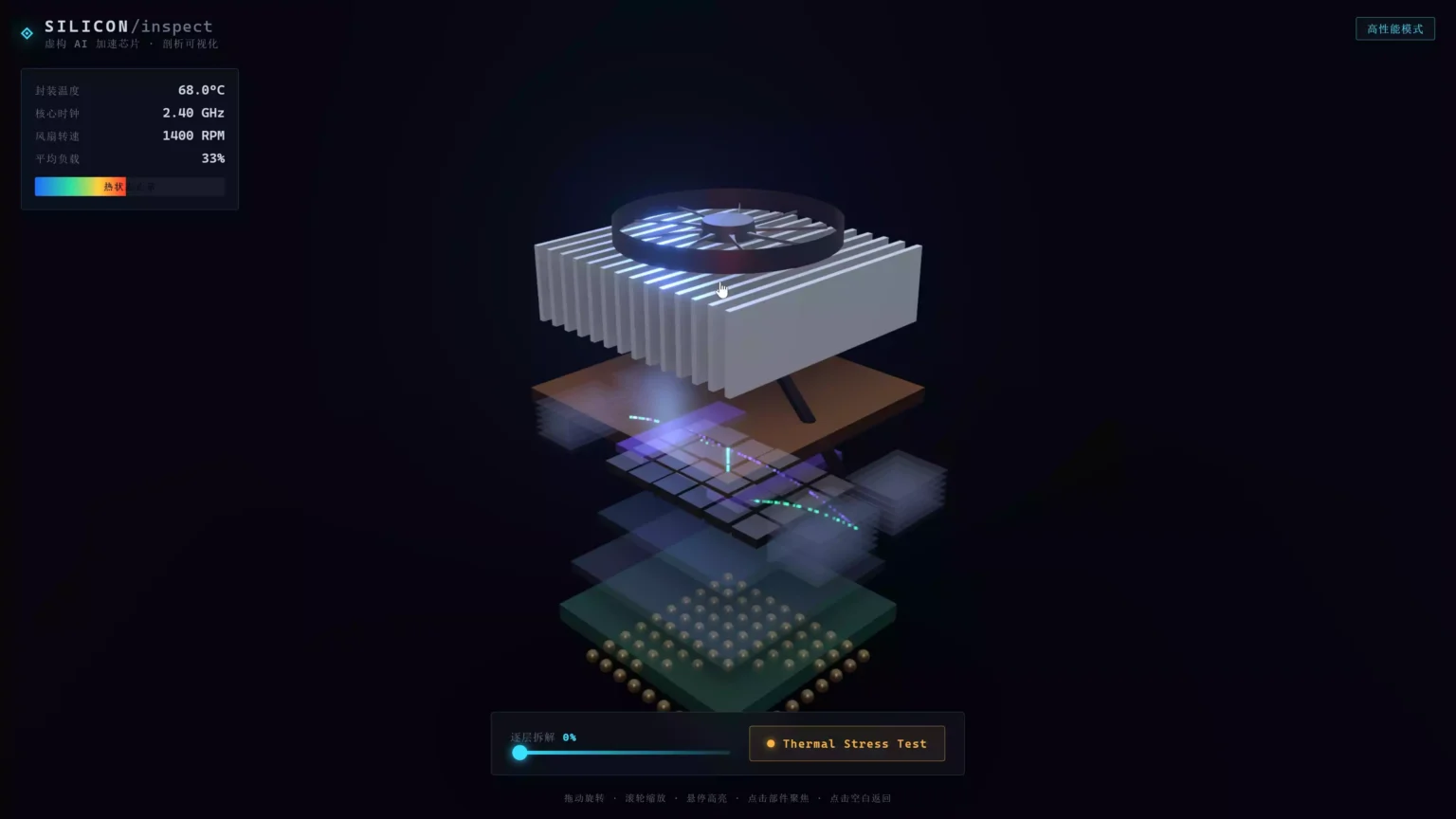
The most impressive demo so far: a developer asked Qwen 3.8 (via Claude Code) to build a complete, interactive 3D AI accelerator chip — entirely from code, with zero external 3D models or textures. The result is extraordinary:
• Full chip architecture — BGA solder balls, substrate, interposer, compute dies, HBM stacks, cache, silicon die, heatspreader, vapor chamber, fin stacks, fans, and package lid — all programmatically generated
• Exploded view animation — a slider smoothly separates each layer along the Y-axis with non-linear spacing, revealing the internal structure
• Real-time heatmap — temperature gradient (blue → green → yellow → red) across the chip surface, with hotter compute cores and cooler heatsink regions
• Data flow visualization — particle streams animate data movement between Compute ↔ Cache ↔ HBM, with density and speed tied to per-core load
• Thermal stress test — click a button to max out all cores, watch temperatures rise, fans spin up, and thermal throttling kick in when thresholds are exceeded
• Per-component info cards — click any component to see name, area (mm²), bandwidth (TB/s), power (W), and current temperature (°C)
The entire application runs smoothly in the browser — even on mobile phones, thanks to automatic performance degradation (reduced particles, lower geometry, no post-processing on mobile). This is not a toy demo. It is a production-quality engineering visualization that would take a skilled Three.js developer days to build. Qwen 3.8 generated it in ~10 minutes.
Test 2: macOS Desktop Clone — 1,500 Lines, Fully Functional
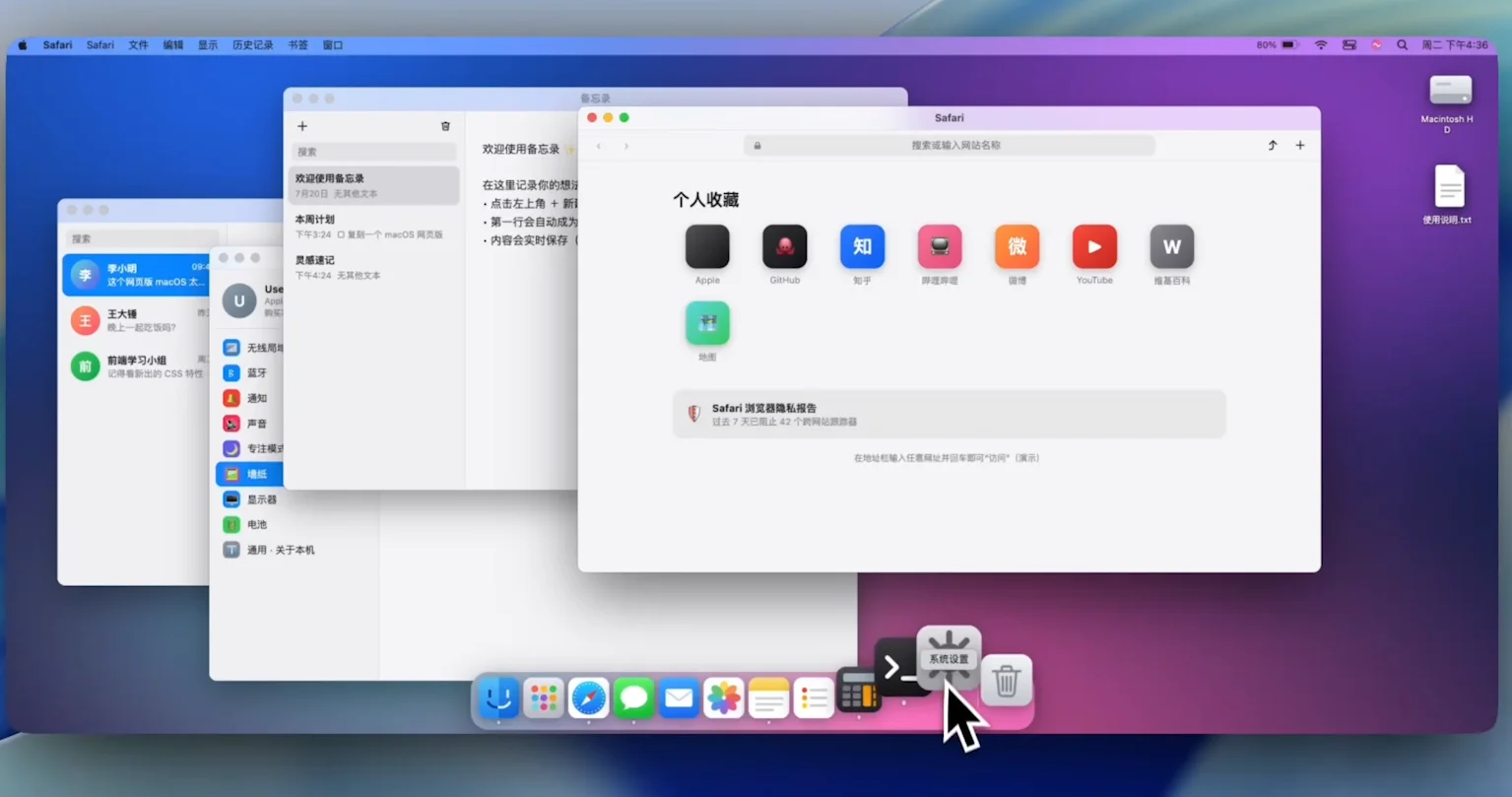
Another developer benchmarked Qwen 3.8, Kimi K3, and Fable 5 on the same prompt: "Recreate the macOS desktop." The results surprised many:
• Qwen 3.8 generated 1,500+ lines of code in a single pass — Dock with animations, menu bar, draggable windows, Spotlight search, Notification Center, and a working Terminal. The overall UI was rated the most polished of the three.
• Kimi K3 produced a functional but less complete version.
• Fable 5 generated a solid result but needed more iterations to match Qwen's UI quality.
The tester's conclusion: "Chinese open-source models are now very close to Fable 5."
Test 3: Game Generation — Plants vs Zombies + Gold Miner
Game generation has become a key benchmark for coding models, and Qwen 3.8 passes with flying colors. With a single prompt for each game:
• Plants vs Zombies-style tower defense: Complete with sun economy, plant placement, zombie waves (10 rounds), a final boss, and the iconic lawnmower last-defense mechanic. All generated in one shot, zero errors.
• Gold Miner: Classic pixel-art style with hook-throwing physics, gold nugget grabbing, a shop system, dynamite, countdown timer, and level progression. Again, one-shot generation, no debugging needed.
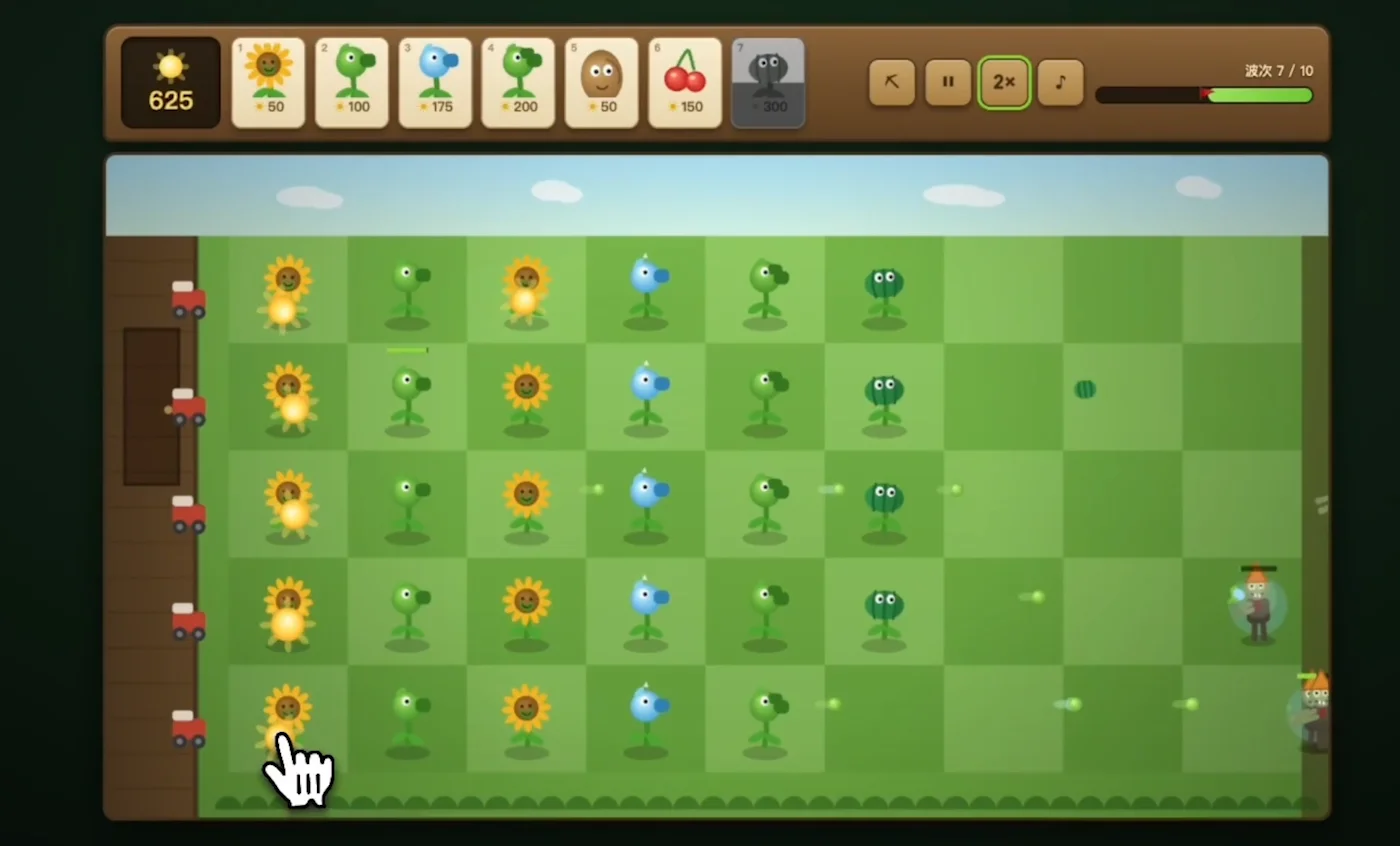
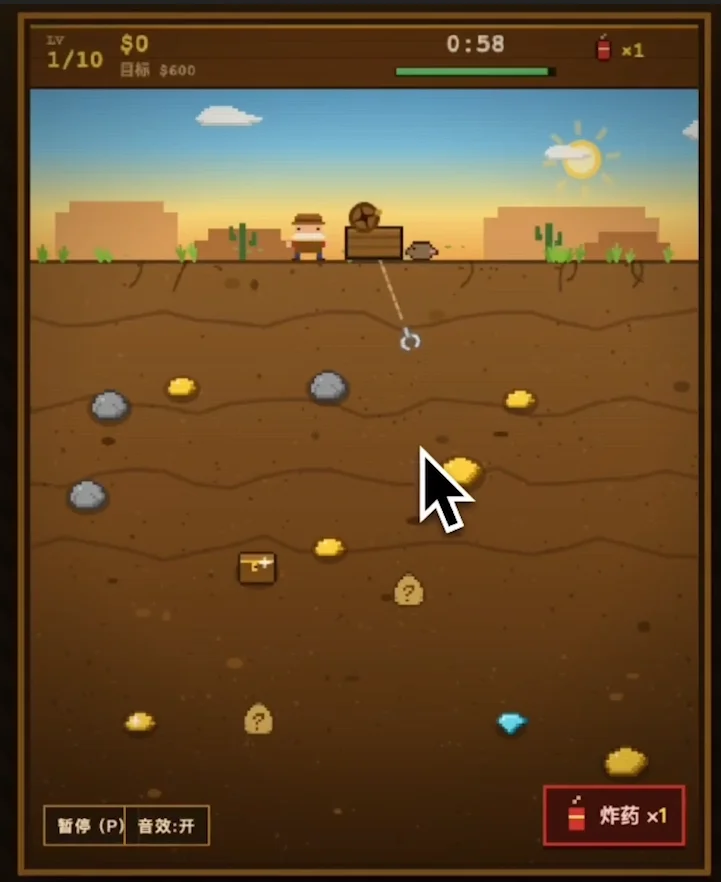
What makes this notable is not just that it works — Claude and GPT can generate games too — but that it works at 1/10th the cost. For indie game developers iterating on prototypes, this cost difference is transformational.
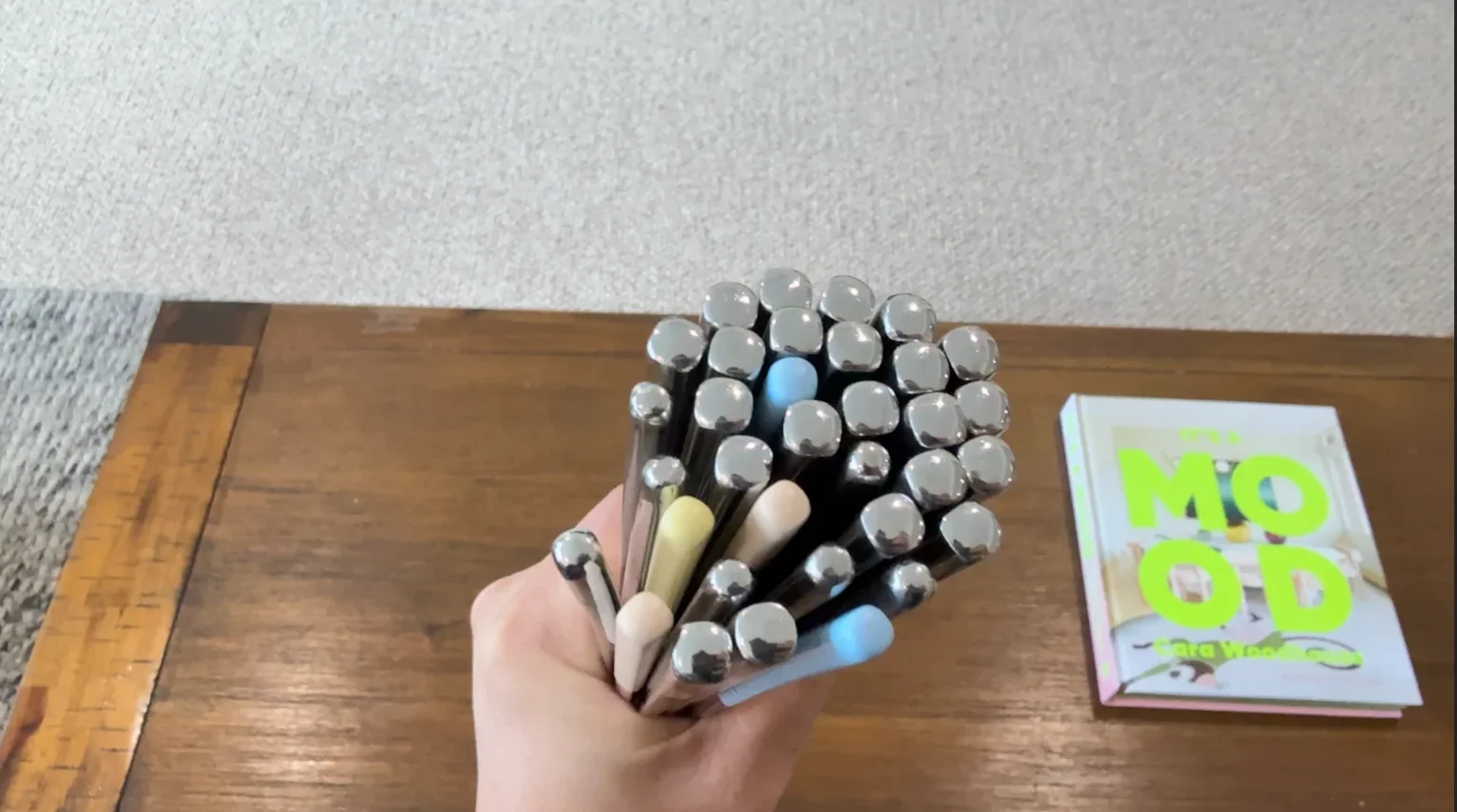
Test 4: Multimodal — Chopstick Counting
Counting chopsticks has become a classic multimodal stress test in the Chinese AI community. It sounds trivial but is surprisingly difficult: models must correctly identify and count thin, overlapping, similarly-colored objects from a photo.
Qwen 3.8 correctly counted:
• Round 1: 34 chopsticks (17 pairs) — breaking down by color: 29 silver, 2 cream, 2 off-white, 1 yellow, 2 light blue
• Round 2: 26 chopsticks (13 pairs) — with different colors and arrangements to prevent lucky guessing
This is a significant improvement over the previous Qwen generation, which struggled with this test. It demonstrates that Qwen 3.8's multimodal capabilities are genuinely competitive, not just a checkbox feature.
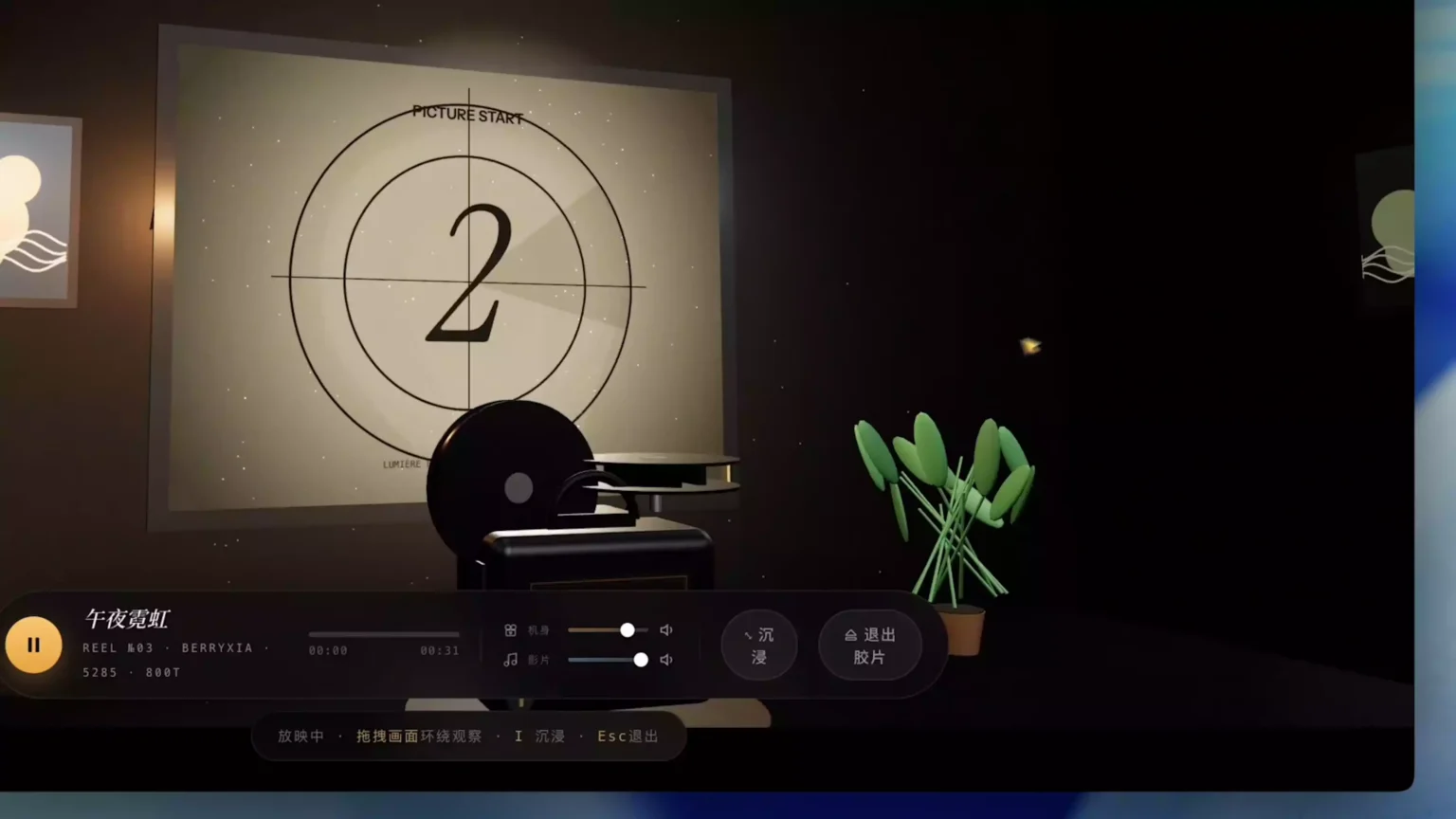
Test 5: Three.js — 3D Film Projector
To test whether Qwen 3.8's 3D skills were limited to the AI chip use case, a developer asked it to create a vintage film projector in Three.js. The result included projection animations, detailed lens mechanics, realistic lighting, rotating gears, and perhaps most impressively — support for uploading local PDF, PPT, and MP4 files to play through the virtual projector. This level of polish and interactivity proves that Qwen 3.8's Three.js capabilities are broad, not narrow.
Test 6: SimCity + Vue Dashboard
Two more community tests worth noting:
• SimCity-style city simulator: One prompt generated a city-building game with AI traffic, building economy, resource management, and road networks. One developer called it "possibly the strongest open-weight coding model" after this test.
• Vue.js VPN Dashboard: 20 minutes, one prompt. Result: polished UI, smooth animations, and near-zero bugs — a fully functional admin dashboard that would normally take a frontend developer hours.
Where Qwen 3.8 Falls Short: The Fable 5 Gap
Qwen 3.8 is not universally better. The clearest gap appears in image-to-3D modeling. When given a multi-angle photo of an ancient Chinese building and asked to reconstruct it in Three.js:
• Fable 5 produced a more accurate model with correct architectural proportions, better structural detail, and higher fidelity to the source image.
• Qwen 3.8 generated a recognizable 3D structure but showed visible deviations in building details and proportions.
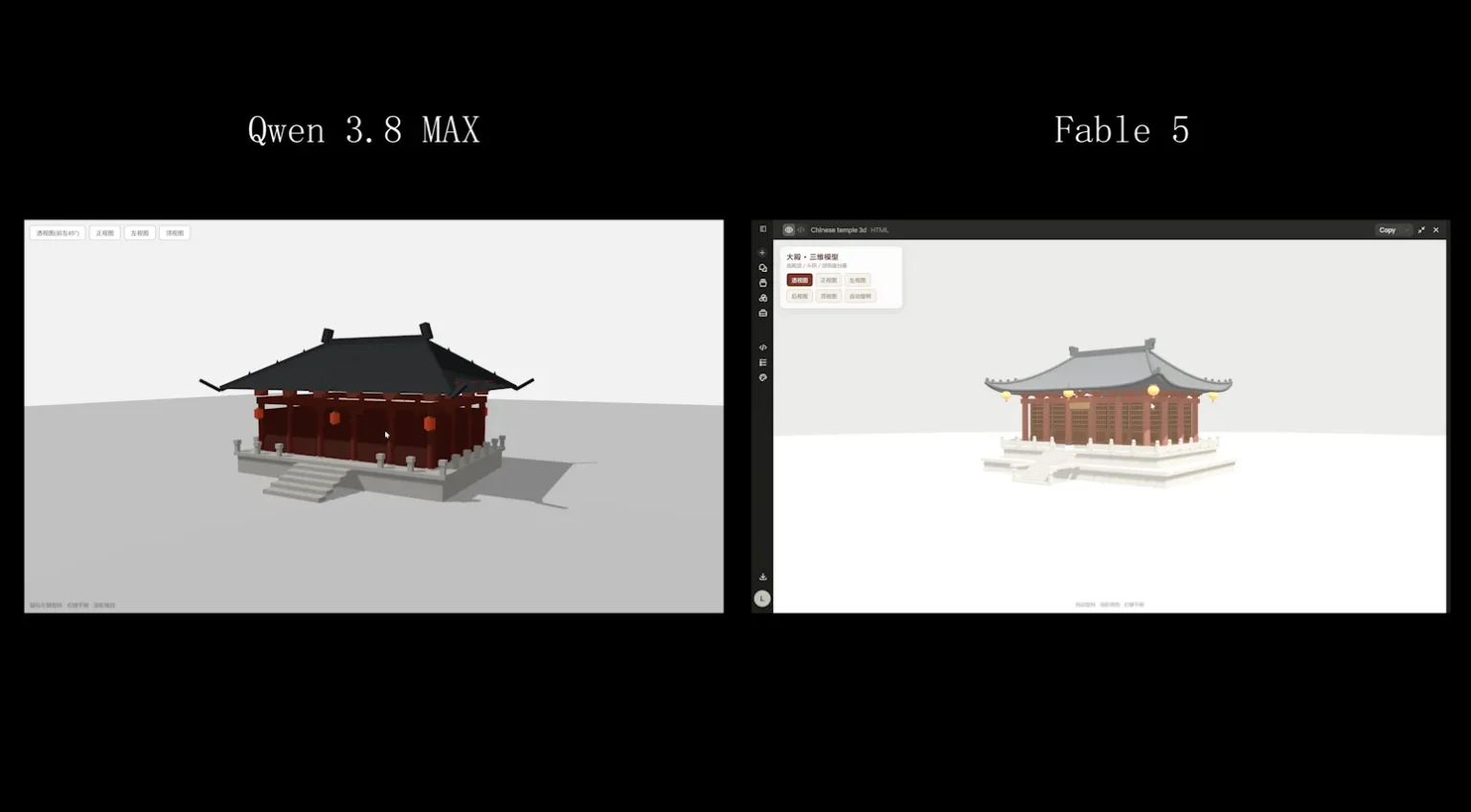
This suggests that while Qwen 3.8 excels at prompt-to-code (text → Three.js), Fable 5 still leads on image-to-code (image understanding → 3D reconstruction). For tasks that require deep visual comprehension of complex scenes, Fable 5 remains the stronger choice.
VoxelArt Bench: The Ranking Picture
The VoxelArt Bench provides a structured comparison for 3D generation capabilities. The current subjective ranking from community testers:
| Rank | Model | Notes |
|---|---|---|
| 🥇 #1 | Fable 5 ≈ Kimi K3 | Top tier for 3D generation and image understanding |
| 🥈 #2 | Qwen 3.8 | Strong prompt-to-3D, slightly behind on image-to-3D |
| 🥉 #3 | GLM-5.2 | Solid all-rounder |
| #4 | Grok 4.5 | Fast but text-only, no 3D generation |
| #5 | GPT-5.6 Sol | Competent but not specialized for this benchmark |
Qwen 3.8 has clearly entered the first tier. For an open-source model still in Preview, being ranked alongside Fable 5 and Kimi K3 is a strong signal of where this model is headed.
Pricing Deep Dive: The Economics of Qwen 3.8
Let's put the pricing in perspective with real task data from community testing:
| Task | Qwen 3.8 | Kimi K3 | Fable 5 |
|---|---|---|---|
| macOS desktop clone (~1,500 lines) | ~0.4 RMB | ~3.4 RMB | ~5.4 RMB |
| Plants vs Zombies game | ~0.4 RMB | ~3.4 RMB | ~5.4 RMB |
| 3D AI chip (full interactive page) | ~0.4 RMB | ~3.4 RMB | ~5.4 RMB |
| Cost per 100 agent tasks | ~$6 | ~$47 | ~$75 |
| Cost per 1,000 agent tasks | ~$60 | ~$470 | ~$750 |
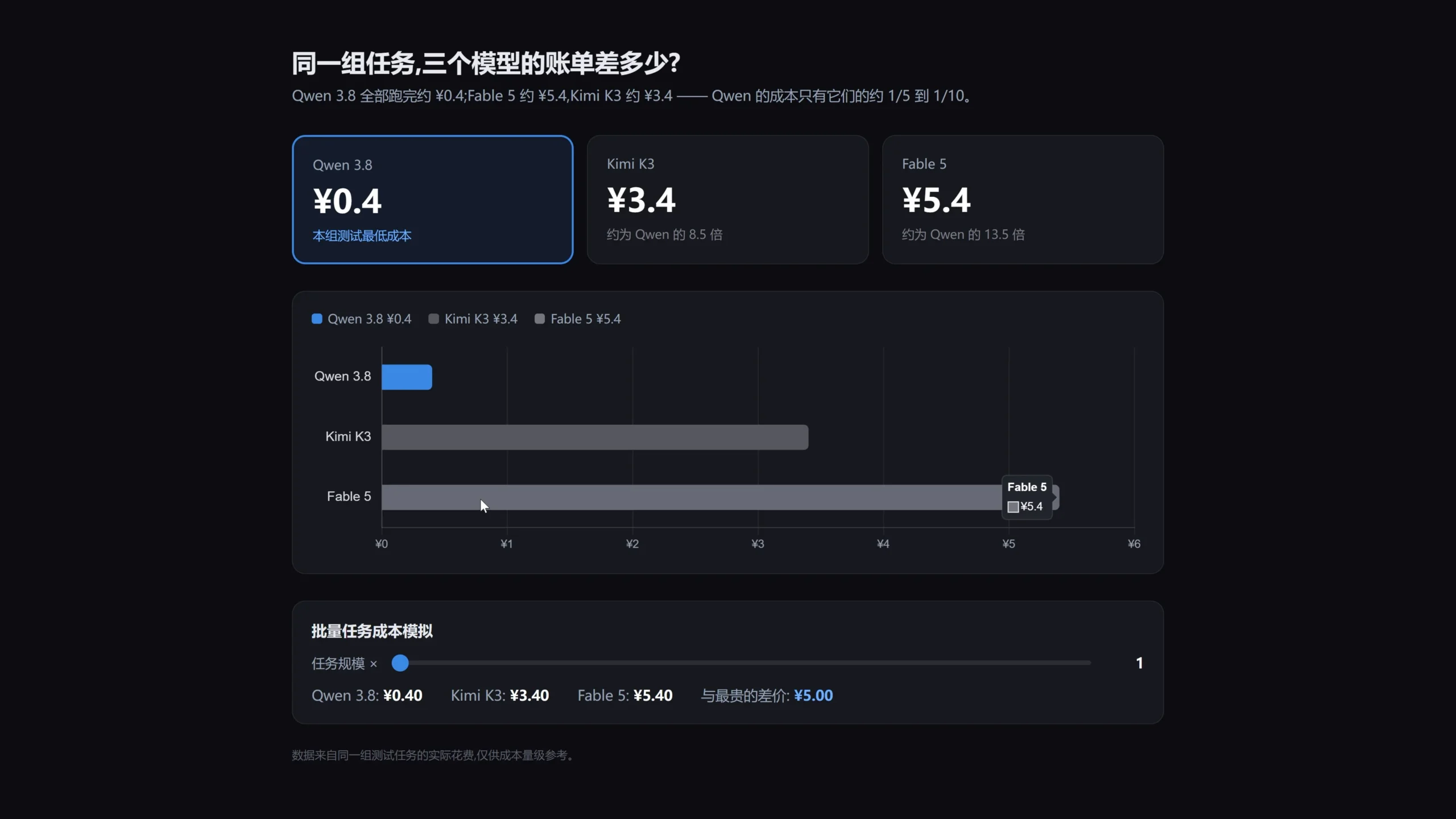
At scale, the difference is stark. A startup running 1,000 agent tasks per month would spend $60 with Qwen 3.8 versus $750 with Fable 5 — a $690/month saving. Over a year, that is $8,280 back in the bank. For bootstrapped teams and indie developers, this is not a marginal optimization; it is the difference between "we can afford to use AI agents" and "we cannot."
Equally important: Qwen 3.8's quality is good enough that you are not sacrificing much. For most coding, game generation, and frontend tasks, the output is indistinguishable from models costing 10x more. The gap only appears on the hardest edge cases (complex image-to-3D, advanced reasoning).
Qwen-Image-3.0: A Bonus Release
Alongside Qwen 3.8 Max Preview, Alibaba also released Qwen-Image-3.0, a new image generation model. It supports ultra-long text prompts (up to 66 parameters/instructions) and complex text-and-image composition. Early outputs show photorealistic results that compete with Midjourney and DALL·E. While not the focus of this review, it signals that Alibaba is building a full multimodal ecosystem around the Qwen brand — text, code, images, and likely video and 3D in the pipeline.
How to Use Qwen 3.8 with Claude Code
Getting started takes under 5 minutes:
1. Install Claude Code:
irm https://claude.ai/install.ps1 | iex (Windows PowerShell)
2. Save this PowerShell script as Qwen3.8.ps1:
$env:ANTHROPIC_AUTH_TOKEN="your-dashscope-api-key"
$env:ANTHROPIC_BASE_URL="https://dashscope.aliyuncs.com/apps/anthropic"
$env:ANTHROPIC_MODEL="qwen3.8-max-preview"
$env:ANTHROPIC_DEFAULT_SONNET_MODEL="qwen3.8-max-preview"
$env:ANTHROPIC_DEFAULT_OPUS_MODEL="qwen3.8-max-preview"
$env:ANTHROPIC_DEFAULT_HAIKU_MODEL="qwen3.6-flash"
$env:CLAUDE_CODE_SUBAGENT_MODEL="qwen3.8-max-preview"
& "$HOME\.local\bin\claude.exe"
3. Right-click → Run with PowerShell. Done. Claude Code now runs on Qwen 3.8.
Replace your-dashscope-api-key with an API key from the Alibaba Cloud dashscope console. The model is currently in free preview, so you pay nothing to test it.
Competitive Landscape: Qwen 3.8 vs the Field
Qwen 3.8 vs Fable 5
Fable 5 still leads on image-to-3D understanding and complex reasoning. But Qwen 3.8 matches or exceeds Fable 5 on prompt-to-code tasks (macOS clone, game generation) — and costs 10x less. If your workflow is primarily text-to-code, Qwen 3.8 is the better value. If you need best-in-class image understanding for 3D reconstruction, stick with Fable 5.
Qwen 3.8 vs Kimi K3
Both are open-source Chinese models released within days of each other. Kimi K3 leads on Frontend Code Arena (#1) and offers multimodal generation (text + image + video + 3D). Qwen 3.8 counters with 2.4T vs 1T+ parameters, Claude Code compatibility, and lower cost. For coding agents, Qwen has the edge. For multimodal content creation, Kimi K3 may be the better pick — though Qwen-Image-3.0 narrows this gap.
Qwen 3.8 vs DeepSeek V4 Pro
DeepSeek's mature open-weight ecosystem and established pricing ($2/$10 per million tokens) make it the safe choice for production. Qwen 3.8 is riskier (Preview, weights not yet released) but potentially much cheaper at scale and arguably stronger on creative coding tasks (Three.js, games).
Qwen 3.8 vs Grok 4.5
Grok 4.5 is fast (80 TPS), free (for now), and integrates with Cursor. But it is text-only — no multimodal, no 3D, no image input. Qwen 3.8 is multimodal, open-source (soon), and compatible with Claude Code. If you only need fast code generation in Cursor, Grok works. If you need a broader toolkit, Qwen 3.8 covers more ground.
Who Should (and Shouldn't) Use Qwen 3.8?
Use Qwen 3.8 if you are:
• A developer who uses Claude Code and wants to cut API costs by 90% without changing your workflow
• An indie game developer who needs rapid, low-cost prototyping of browser games
• A Three.js / frontend developer who wants AI-generated 3D visualizations at near-zero cost
• A startup or team running hundreds of agent tasks per day — the cost savings compound fast
• An open-source advocate who wants to bet on a model that will be freely available for self-hosting
Skip Qwen 3.8 if you:
• Need best-in-class image understanding for 3D reconstruction — Fable 5 still leads here
• Require production-stable, guaranteed-available API with SLAs — wait for the official release
• Need multimodal generation (images, video) from a single model — Kimi K3 covers this natively
• Want a polished consumer app — Qwen 3.8 is API-only; you need a frontend
• Are locked into the OpenAI SDK ecosystem — Qwen uses the Anthropic-compatible API format
FAQ
Is Qwen 3.8 really free?
The Preview version is currently free to use via Alibaba Cloud's dashscope API. Long-term pricing has not been announced, but based on current per-task costs (~0.4 RMB), even paid pricing is likely to be extremely competitive.
Can Qwen 3.8 replace Claude Code's default models?
Yes — by setting the environment variables shown above, Claude Code will route all requests through Qwen 3.8 instead of Anthropic's models. The subagent model can be set to the faster Qwen 3.6 Flash for lighter tasks.
Does Qwen 3.8 support image uploads?
Yes, multimodal input is supported. It can analyze images, count objects, read text from screenshots, and understand visual scenes. Image generation is handled by the separate Qwen-Image-3.0 model.
When will the open-source weights be released?
Alibaba has confirmed the model will be open-sourced with the official release, but has not given a specific date. The current timeline is "soon" based on official communications.
How does Qwen 3.8 compare to Claude Fable 5?
On pure coding benchmarks, Qwen 3.8 is competitive — matching or exceeding Fable 5 on some prompt-to-code tasks at 10x lower cost. On image-to-3D and complex visual reasoning, Fable 5 still holds a clear lead. For most developer workflows, the cost-performance ratio strongly favors Qwen 3.8.
Is Qwen 3.8 available outside China?
Yes — the dashscope API is accessible globally. You need an Alibaba Cloud account and an API key, both of which are available internationally.