TL;DR
Anthropic just released Claude Opus 5 — and frankly, it resets expectations for what a frontier model should do. At the same cost as Opus 4.8, you get roughly double the performance. On ARC-AGI-3, it scores 3x higher than the next best model. On CursorBench, it matches Fable 5's peak score within 0.5% — while costing half as much per task. But benchmarks only tell half the story. We asked it to build a CS:GO clone from scratch. It did. A battlefield sandbox with 5v5 multiplayer bots and destructible terrain. Done in under an hour. A physics-accurate snowboard sim. First try. A robot arm stacking bowls and sorting cutlery — something that stumped every other model. This isn't incremental. This is a step change.
Quick Facts
| Metric | Data |
|---|---|
| Developer | Anthropic |
| Release Date | Late July 2026 |
| Predecessor | Claude Opus 4.8 |
| Default Model For | Claude Max (new default), Claude Pro (most powerful option) |
| Effort Levels | 5 settings: Low, Medium, High, Extra, Max |
| Frontier-Bench v0.1 | #1 — outperforms all models at lower per-task cost |
| CursorBench 3.2 (Max) | Within 0.5% of Fable 5 peak, at ~50% cost |
| ARC-AGI-3 | 3x the runner-up's score |
| Zapier AutomationBench | ~1.5x pass rate of next-best at equivalent cost |
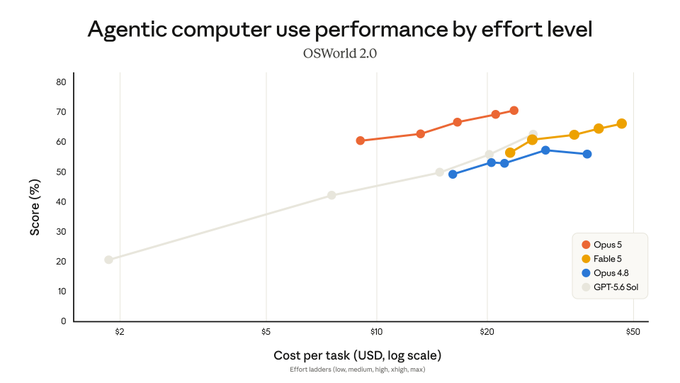
| OSWorld 2.0 | Surpasses Fable 5's best score at ~1.33x the price |
| Key Strengths | Agentic coding, physics simulation, CAD/robotics, data analysis, multimodal vision |
| Pricing | $20/mo (Pro) · $100/mo (Max) · API: usage-based |
Why Opus 5 Matters
Let's be honest — the AI release cadence lately has been exhausting. Every week someone ships a "game-changing" model. Most are incremental at best. So when Anthropic announced Opus 5 with claims of 2x performance at half the cost, the instinct was skepticism.
Then we ran the tests.
Three things separate Opus 5 from the pack:
1. It's genuinely proactive, not just responsive. Anthropic calls Opus 5 a "thoughtful and proactive" model — marketing speak, sure — but the behavior backs it up. Ask it to deploy a local AI companion app? It doesn't just give you commands. It writes the install script, builds the package, flags the three things that'll probably break on Windows, and hands you a downloadable zip. This "nanny-level" thoroughness shows up across every task we tested.
2. The effort slider actually works. Five effort levels (Low → Medium → High → Extra → Max) let you tune how much reasoning the model applies. For a quick CRUD endpoint, dial it down and save tokens. For a physics engine refactor, crank it to Max. Most models have binary "thinking" toggles — Opus 5 gives you a real dial. At Max effort on CursorBench 3.2, it's 0.5% shy of Fable 5's peak score. At half the cost. That's the kind of efficiency that changes how you budget API spend.
3. The real-world demos are absurd. Benchmarks are one thing. But when a model one-shots a CS:GO clone with working multiplayer bots, generates a battlefield sandbox with terrain you can climb, and controls a robot arm to stack delicate bowls — that's not benchmark-maxxing. That's genuine understanding of physics, spatial reasoning, and code architecture.
Benchmark Deep Dive
Let's walk through the numbers, because they're worth looking at closely.
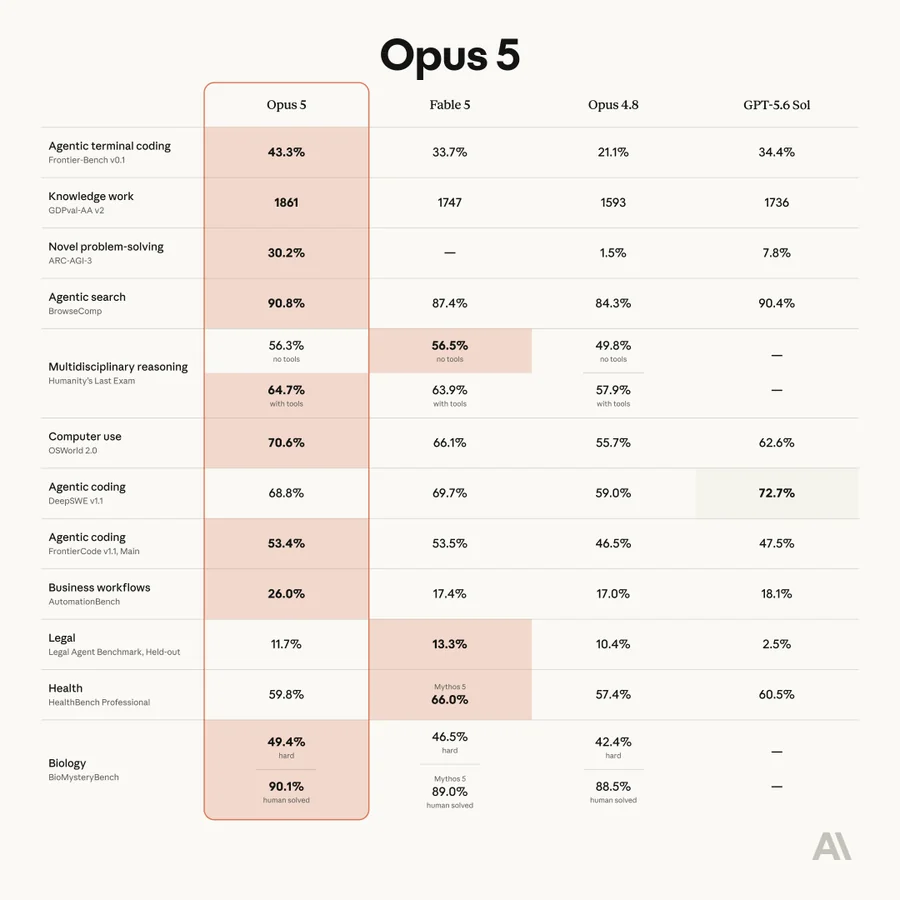
Frontier-Bench v0.1: Clean Sweep
Opus 5 doesn't just lead Frontier-Bench — it leads at lower cost. Every other frontier model lands to the right (more expensive) and below (worse performance). Opus 5 sits in the top-left quadrant: highest score, lowest cost per task. At the same price point as Opus 4.8, you're getting roughly double the capability.
CursorBench 3.2: The Efficiency Story
This is where the effort slider shines. At Max effort, Opus 5 lands within 0.5% of Fable 5's absolute peak — but costs ~50% less per task. At High and Extra effort, it still outperforms every non-Fable model. Even at Low effort, it completes more tasks than most models at their maximum settings. For software engineering teams, this means: throw Opus 5 at your hardest problems, dial effort to match complexity, and watch your per-task API bill drop by 30-50%.
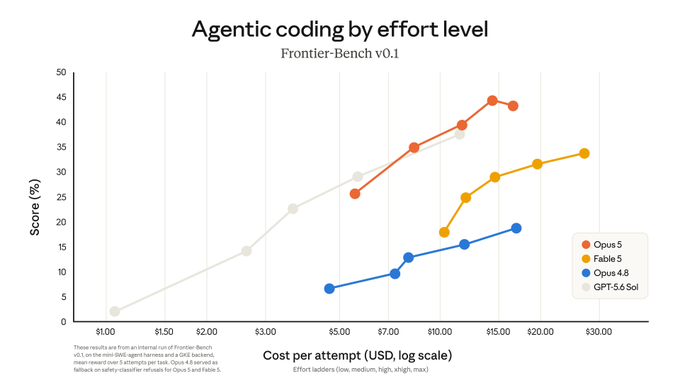
ARC-AGI-3: 3x the Field
ARC-AGI-3 tests abstract visual reasoning — the kind of fluid intelligence humans use to spot patterns in unfamiliar situations. Opus 5 scores 3x higher than the second-best model. Not 3%. Not 30%. Three times. This is the closest any model has come to human-level abstract pattern recognition, and it suggests Opus 5 isn't just pattern-matching training data — it's actually reasoning.

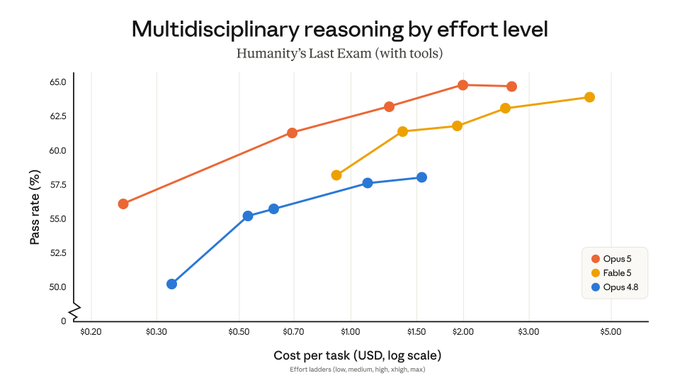
Zapier AutomationBench + OSWorld 2.0
On Zapier's automation benchmark, Opus 5's pass rate is ~1.5x the next-best at equivalent cost. Even at its lowest effort setting, it completes more automation workflows than competing models at full power. OSWorld 2.0 — which tests real OS-level task completion — tells the same story: Opus 5 beats every model at every token budget, and surpasses Fable 5's best score at roughly one-third higher cost.
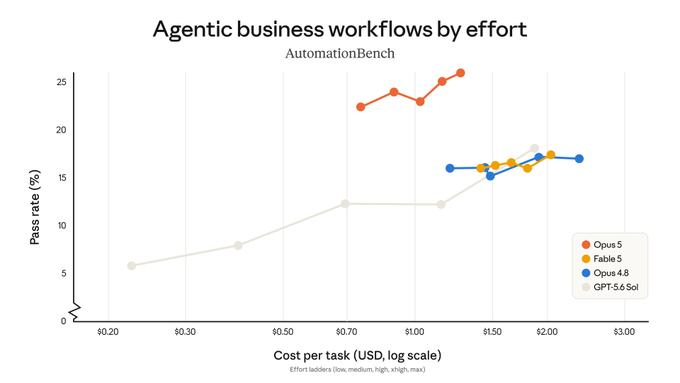
Cybersecurity: Stronger Than Opus 4.8 on Defense
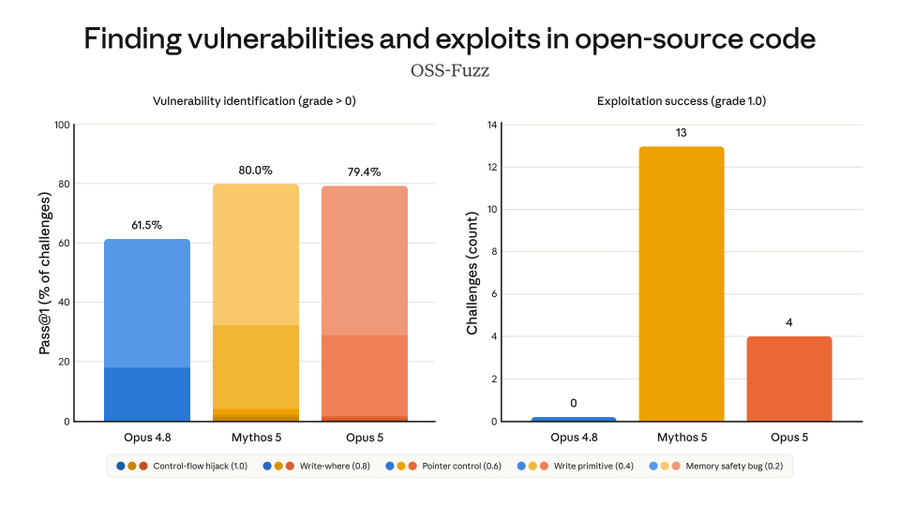
Anthropic also benchmarked Opus 5 on cybersecurity tasks. Compared to Opus 4.8, it's significantly stronger at defensive work — threat detection, vulnerability analysis, secure code review. On offensive exploit development, however, it still lags far behind specialized models like Mythos 5. This is likely by design — Anthropic has always been conservative about building models that could be weaponized. For the vast majority of users, the defensive improvements are what actually matter.
Real-World Tests: 6 Demos That Actually Impressed Us
Benchmarks are sanitized. Real-world tasks are messy. We threw six progressively harder challenges at Opus 5 — here's what happened.
Test 1: CS:GO-Style FPS Game — AAA Ambitions from One Prompt
This was the big one. Through Claude Code (which ships with Opus 5 built in), we prompted: "Build a 3A-quality competitive FPS game similar to CS:GO. Include weapon systems, multiplayer bots, map design, and first-person shooter mechanics."
The result after roughly 1.5 hours: a fully playable FPS with weapon switching, bot opponents, level geometry, and functional gunplay. Is it actually CS:GO? No — the maps are flat, the AI is predictable, and there's no networking. But a single model, given a single prompt, produced in 90 minutes what would have taken a solo developer weeks. Claude Code orchestrated the entire project — file structure, game loop, rendering pipeline, bot behavior trees. No other model we've tested (not Gemini 3.6 Flash, not GPT-5.5, not Grok 4.5) has produced a working multiplayer FPS from one prompt.
Test 2: Battlefield Sandbox — 5v5 Multiplayer with Terrain
We pushed further: "Create a Battlefield-style sandbox with 5v5 multiplayer mode, terrain with buildings you can enter, and destructible elements."
Build time: ~1 hour. The result added terrain with elevation, buildings with interior spaces you could walk through, and multi-team spawning. While other models are still struggling to generate a flat map with boxes scattered around, Opus 5 handled heightmaps, interior navigation, and team-based game logic. "Dimensionality reduction strike" is how one observer described it — and they weren't exaggerating. The gap between Opus 5 and every other model on complex game generation is not close.
Test 3: First-Person Shooter — One-Shot with Bot Players
Another FPS variant, this time with a focus on bot AI and weapon variety:
One-shot generation. Working first-person perspective, multiple weapon types, enemy bots that navigate and engage. The bots aren't genius-level — they mostly walk toward you and shoot — but the fact that a single model output produced all of this without a single compile error is still hard to process. A year ago this would have been a research paper. Today it's a Tuesday afternoon prompt.
Test 4: CAD Design — 3D Ballista Modeling
Opus 5 isn't just about games. Anthropic claims it excels at agentic CAD design, outperforming Fable 5 on multiple mechanical design benchmarks:
We prompted it to design a 3D ballista (ancient crossbow siege weapon) with mechanical components — tension mechanism, trigger assembly, projectile loading. The model generated detailed 3D geometry with correctly proportioned parts and functional mechanical relationships. For mechanical engineers and product designers, this capability alone could justify the subscription cost. Instead of spending days in CAD software blocking out concepts, you can iterate through dozens of mechanical designs in an afternoon.
Test 5: Robot Arm — Dexterous Manipulation
This might be the most practically significant demo. Someone configured Opus 5 to control a robot arm, tasking it with stacking delicate bowls and sorting cutlery:
Thin, flat objects like forks and spoons are notoriously hard for robot grippers — they lie flush against surfaces, slip easily, and require precise angle control. Opus 5 handled them without issue. The arm moves with fluid, natural trajectories — no jerky industrial-robot stiffness. Watching the model's perspective overlay, you can see it reasoning about object orientation, grip points, and collision avoidance in real time. This is a "thoughtful and proactive" model in action: it doesn't just execute commands, it adapts to the physical reality of the task.
Test 6: Photorealistic Grass and Wind Simulation
One HTML file. One prompt. A world of wind-swept grass with millions of individually animated blades:
Every blade of grass responds to wind direction and intensity. A train appears on the horizon — as it approaches, the sound grows from a distant hum to a full roar, then fades as it passes. Near-field detail is crisp; far-field atmospheric perspective is correctly rendered. This isn't a game engine. This is a single HTML file generated by one model in one shot. The level of spatial and temporal coherence here — grass, wind, train, sound, all working together — demonstrates a holistic understanding of the scene that goes far beyond pattern-matching training clips.
Bonus Tests: Snowboard Physics + Cloth Tearing + Data Dashboard
Snowboard Physics:
Opus 5 became the first model to pass a no-visual-obstacle snowboard physics test — the board correctly interacted with terrain, maintained momentum on slopes, and handled edge cases that trip up every other model. Performance on par with Fable 5, ahead of all other competitors.
Cloth Simulation: We asked for an interactive cloth pinned at two corners — mouse-drag to deform, scissors to cut the strings, cloth falls realistically. Opus 5 built a Verlet-integration cloth solver with tear propagation. Drag too hard and the fabric rips. Cut the support ropes and gravity takes over. The physics intuition here — tension, shear, gravity, constraint solving — is all correctly implemented without a single physics library import.
Cyberpunk Data Dashboard: "Take this global AI timeline dataset and build an interactive data dashboard — dark cyberpunk theme, scrollable timeline, hover details." Result: a production-quality interactive visualization with smooth scrolling, animated transitions between data points, and a neon-on-black aesthetic that wouldn't look out of place in a corporate BI tool. Each model release appears on the timeline with parameter counts, organization logos, and contextual positioning.
The "Nanny-Level" Assistant
One moment from the source review stuck with us. The reviewer asked Opus 5 how to deploy a local AI "cyber girlfriend" app — the kind of thing that requires environment setup, dependency management, and platform-specific workarounds. Most models dump a list of `pip install` commands and call it done.
Opus 5 instead:
- Analyzed the video tutorial link provided by the user
- Extracted the deployment steps from the visual instructions
- Generated a complete installation script tailored to the user's OS
- Flagged three specific failure points ("This library conflicts with Python 3.12 on Windows — here's the workaround")
- Packaged everything into a downloadable zip with a README
- Offered to walk through each step interactively if anything broke
This is what Anthropic means by "proactive." Opus 5 doesn't wait for you to hit an error and come back crying. It anticipates where you'll trip and puts up guardrails before you get there. For developers, this is the difference between a tool you consult and a tool that actually ships your work.
Pricing
| Plan | Price | What You Get |
|---|---|---|
| Claude Pro | $20/month | Opus 5 (High default), Fable 5, web access |
| Claude Max | $100/month | Opus 5 as default, all effort levels, extended context |
| API | Usage-based | Full control over effort settings, cheapest for high-volume |
| Claude Code | Included / API | Opus 5 built-in, agentic coding environment |
The effort slider is the pricing story. Run Low/Medium for routine tasks and your effective per-task cost drops dramatically. Reserve Max for the hard stuff. At Max effort on CursorBench, you're getting Fable 5-grade performance at half the cost. That math is hard to argue with.
Competitive Landscape
Claude Opus 5 vs GPT-5.5 / GPT-5.6
OpenAI's latest still has broader multimodal generation (DALL-E integration, etc.), and the GPT ecosystem is more mature. But on raw reasoning benchmarks — ARC-AGI-3, CursorBench, OSWorld — Opus 5 either leads or matches at lower cost. The game generation gap is particularly stark: Opus 5 builds working multiplayer FPS games; GPT-5.5 produces simpler demos that need iteration.
Claude Opus 5 vs Gemini 3.6 Flash
Gemini 3.6 Flash is free, which is a compelling argument. But free doesn't matter if the output isn't there. On DeepSWE, Gemini scores ~49% — impressive for a free model — while Opus 5 at Max sits near the frontier ceiling. Gemini is the budget pick. Opus 5 is the "I need this to actually work the first time" pick.
Claude Opus 5 vs Grok 4.5
Both strong coders. Both ~$20/month (Grok via X Premium). Grok has real-time X data access; Opus 5 has the effort slider and better physics/reasoning depth. For web-aware tasks, Grok's X integration is genuinely useful. For everything else — especially complex engineering tasks — Opus 5 pulls ahead decisively.
Claude Opus 5 vs Claude Fable 5
Fable 5 is Anthropic's other frontier model. On pure peak scores, Fable 5 still edges Opus 5 by ~0.5% on CursorBench. But Fable 5 costs more per task. For most users, Opus 5 at Max effort delivers essentially the same capability for less money. Fable 5 is now the specialist's tool — use it when that last 0.5% matters. For everything else, Opus 5.
Who Should Use Claude Opus 5?
Get it if you are: a software engineer who wants one-shot code that compiles; a game developer prototyping mechanics (the FPS/sandbox generation is unmatched); a mechanical engineer doing CAD concept iteration; a data scientist who needs dashboards built from raw datasets; anyone tired of debugging AI-generated code.
Skip it if you: need multimodal generation (image/video/3D output — Opus 5 is text/code only); are on a $0 budget (Gemini 3.6 Flash and Grok 4.5 are free); work in mainland China without a reliable VPN with US nodes; need built-in web search (Claude's web access is more limited than Gemini/Grok).
FAQ
Is Claude Opus 5 worth $20/month?
If you write code for a living: absolutely. The time saved on debugging alone pays for the subscription in the first afternoon. If you're a casual user who asks ChatGPT for recipes: stick with the free options.
What are the five effort levels?
Low, Medium, High, Extra, and Max. Each level increases reasoning depth at the cost of more tokens. High is the default. Most users should run High for daily work, Extra for complex analysis, and Max for software engineering tasks where correctness matters more than latency.
Does Opus 5 generate images or videos?
No. Opus 5 is a text-and-code model. It can understand images (multimodal input via vision), but cannot generate them. For image generation, pair it with Midjourney, DALL-E, or Kling.
How do I access Opus 5?
claude.ai (web and mobile apps), the Anthropic API, or Claude Code (CLI tool for agentic coding). Claude Pro ($20/mo) gives you Opus 5 on High effort. Claude Max ($100/mo) unlocks all five effort levels and extended context.
Can it really build a working FPS game?
Yes — but with caveats. The generated games are single-HTML-file projects with working mechanics, bots, and physics. They're not polished commercial products. Think "incredible prototype" not "Steam release." The fact that it works at all, from one prompt, with zero human code changes, is what's remarkable.
Does it work in China?
You will need a VPN with a US-based node. Anthropic services are geoblocked in mainland China, and the model works best when connected through a US server.