I Tested AlphaSense Like an Analyst Would — Here Is What Happened
I am not an institutional investor. But for two weeks, I pretended to be one.
My test scenario: a fictional tech-sector analyst covering NVIDIA, Microsoft, and Amazon. I tasked myself with answering three real questions that an analyst might face:
- Is NVIDIA’s management changing its tone about AI chip demand?
- What are Microsoft’s competitors saying about Copilot adoption?
- Are Amazon’s margins improving or deteriorating in AWS?
I picked these questions because they cannot be answered with a stock chart. You need to read earnings calls, analyst reports, and expert interviews — exactly the kind of unstructured business information AlphaSense claims to organize.
Here is what the tool actually felt like to use.
What AlphaSense Actually Does (And Does Not Do)
AlphaSense is not ChatGPT for finance. It is not a Bloomberg Terminal replacement. And it is definitely not PitchBook.
The simplest description I can give: AlphaSense is a search engine purpose-built for business documents. SEC filings, earnings call transcripts, equity research reports, expert interview transcripts, press releases, and news — all indexed and cross-referenced so you can find signals across hundreds of documents in seconds.
Founded in 2011 and now valued at roughly $4 billion, AlphaSense claims its platform contains hundreds of millions of business documents. Its customers are almost entirely institutions: investment firms, consulting companies, and corporate strategy teams.
The core pitch is simple: instead of spending hours Ctrl+F-ing through PDFs and transcripts, you search once and get structured results with keyword highlighting, sentiment analysis, and topic clustering.
Does it deliver? Mostly. But only if you already know what you are looking for.
The Watchlist: Where AlphaSense Earns Its Keep
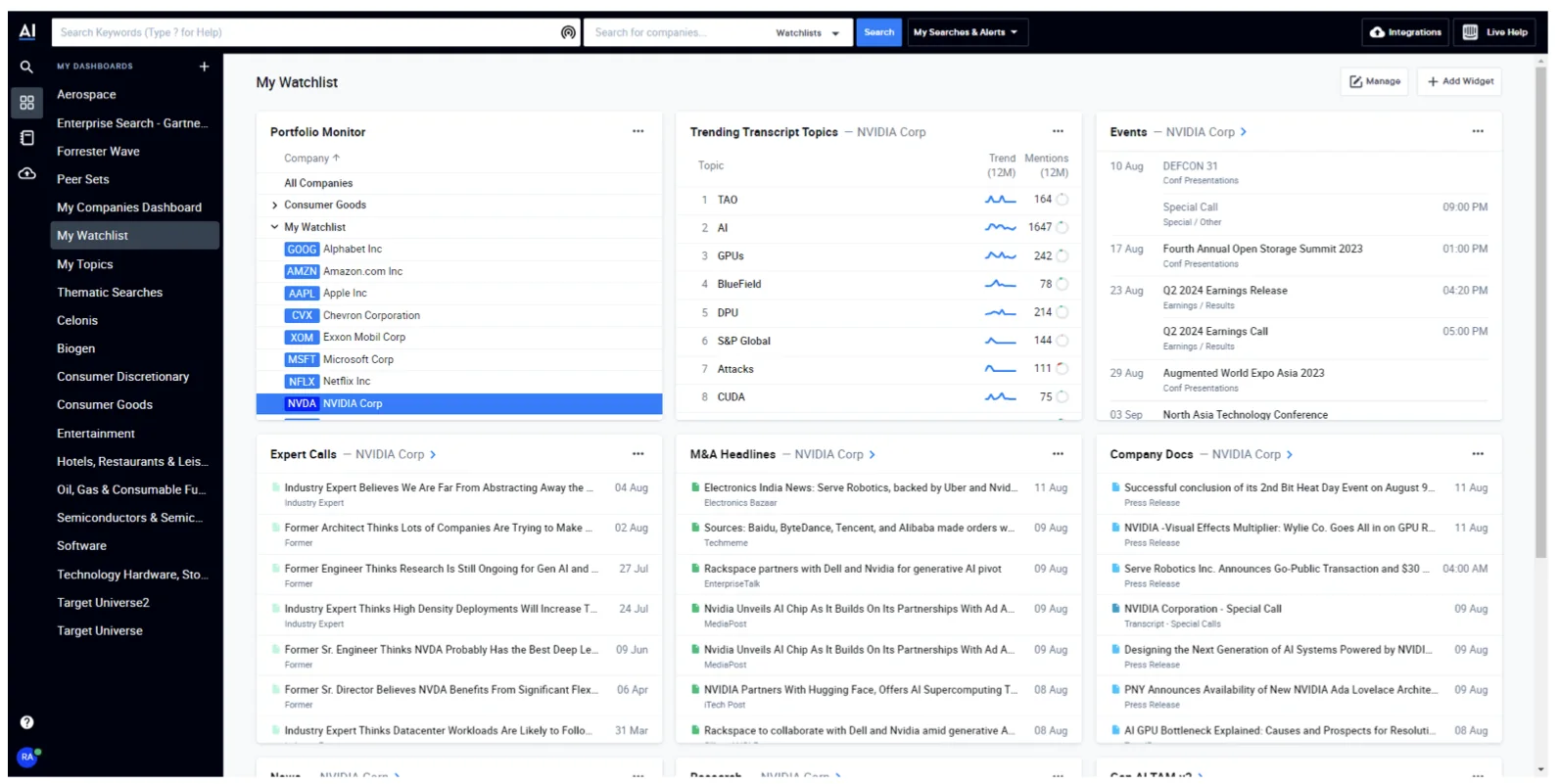
I set up watchlists for NVIDIA, Microsoft, and Amazon. Each watchlist aggregates:
- Upcoming and past earnings calls with full transcripts
- Expert interview transcripts mentioning the company
- SEC filings as they drop
- Analyst research reports
- News coverage from business sources
The dashboard is busy but functional. After a day of tweaking, I had a feed that felt like a custom research terminal for my three companies. Every day I logged in, new documents were flagged — earnings transcripts, competitor mentions, industry reports.
For the NVIDIA question about AI chip demand, I searched “AI demand” across my watchlist and immediately got highlighted results from the last two quarters of earnings calls, plus three expert interviews discussing semiconductor capacity. Manually pulling all of that together would have taken an afternoon. AlphaSense did it in under a minute.
The Document Analysis: Smart Search, With Limits
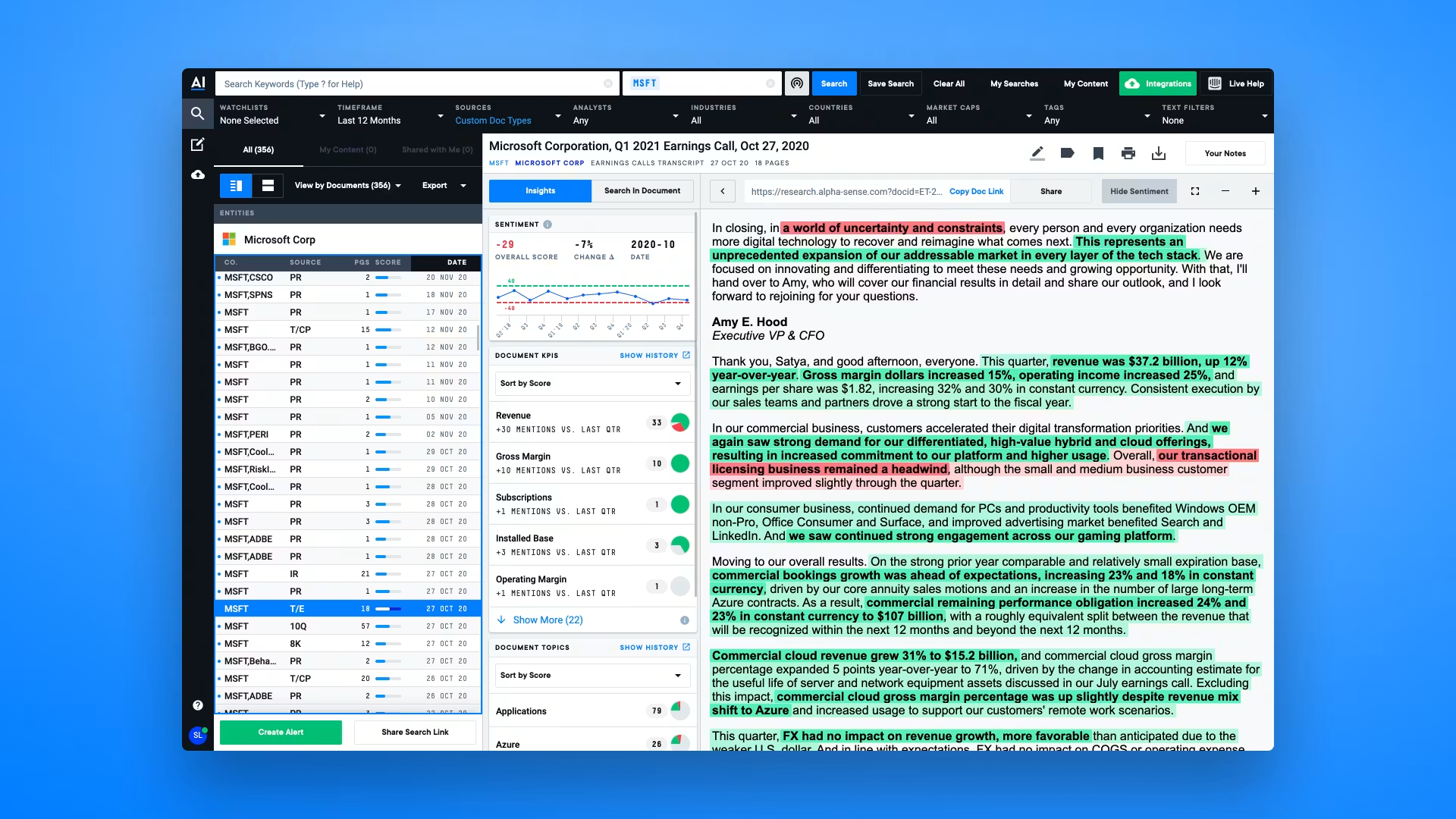
AlphaSense’s search is smarter than “find word X in document Y.” It uses something called Smart Synonyms — it automatically expands your search to related terms. Search for “AI demand” and it also surfaces documents mentioning “AI capex,” “GPU orders,” or “accelerator investment.”
The sentiment analysis flags whether management commentary is positive, negative, or neutral. In one earnings transcript, it highlighted that NVIDIA’s CFO used increasingly cautious language about China revenue compared to the previous quarter. The numbers looked fine. The tone had shifted. That is the kind of signal a spreadsheet cannot catch.
The limitation: AlphaSense does not generate analysis for you. It surfaces documents and highlights passages. You still need to read, interpret, and synthesize. For professional analysts, that is fine — they want to do their own thinking. For someone expecting AI to write their research memo, this is not that tool.
Where AlphaSense Fits vs. Where It Does Not
There is a temptation to compare every research tool as a direct competitor. In practice, most institutional analysts use three to five tools. Here is how AlphaSense slots into a real stack:
Bloomberg Terminal answers: What is the stock price? What are the bond yields? Show me real-time market data.
FactSet answers: Build me a DCF model. What are the consensus earnings estimates? Show me peer company financials.
PitchBook answers: Who invested in this startup? What was the valuation? Show me comparable private market deals.
AlphaSense answers: What did management say about margins last quarter? Which competitors are gaining share? What are industry experts saying about this trend?
None of these tools replaces the others. Bloomberg gives you numbers. FactSet gives you models. PitchBook gives you private market data. AlphaSense gives you the qualitative context behind the numbers.
For my fictional analyst workflow, the combination that made the most sense was: Bloomberg for market data, FactSet for financials, and AlphaSense for management commentary and competitive intelligence. The three tools together covered most of what I needed, at a combined cost that would easily exceed $40K per year for a single seat.
What Users Actually Complain About
I read through reviews on G2 and TrustRadius to supplement my own testing. The patterns are consistent:
The learning curve is real. AlphaSense has search, alerts, dashboards, document views, topic tracking, Smart Synonyms, sentiment filters, and export tools. New users reported taking weeks to feel proficient. This is not a tool you pick up in an afternoon.
Pricing is opaque. There is no pricing page. You contact sales, they qualify you, and you get a quote. Based on what users report, individual seats start around $8,000 per year, with discounts for larger deployments. For institutions spending six figures on Bloomberg terminals, that is reasonable. For an individual researcher or small firm, it is hard to justify.
It is not a complete platform. Several G2 reviews from analysts at smaller firms noted they tried to use AlphaSense as a Bloomberg replacement and were disappointed. No real-time market data. No trading. No portfolio analytics. These are not bugs — AlphaSense was never designed to do those things — but the expectation mismatch is common.
Who Should Actually Pay for AlphaSense
Worth it if: You are an investment analyst, consultant, or corporate strategist who spends more than 10 hours a week reading earnings calls, industry reports, and expert interviews. AlphaSense will cut that time significantly.
Skip it if: You need real-time market data, you are buying a single seat at a small firm with a tight budget, or your research needs are occasional rather than daily.
The honest take: AlphaSense is genuinely good at what it does. It is also genuinely expensive and genuinely overkill for anyone who is not a professional researcher. For the right user, it pays for itself in saved time within the first month. For everyone else, it is a Porsche you are only allowed to drive to the grocery store.